

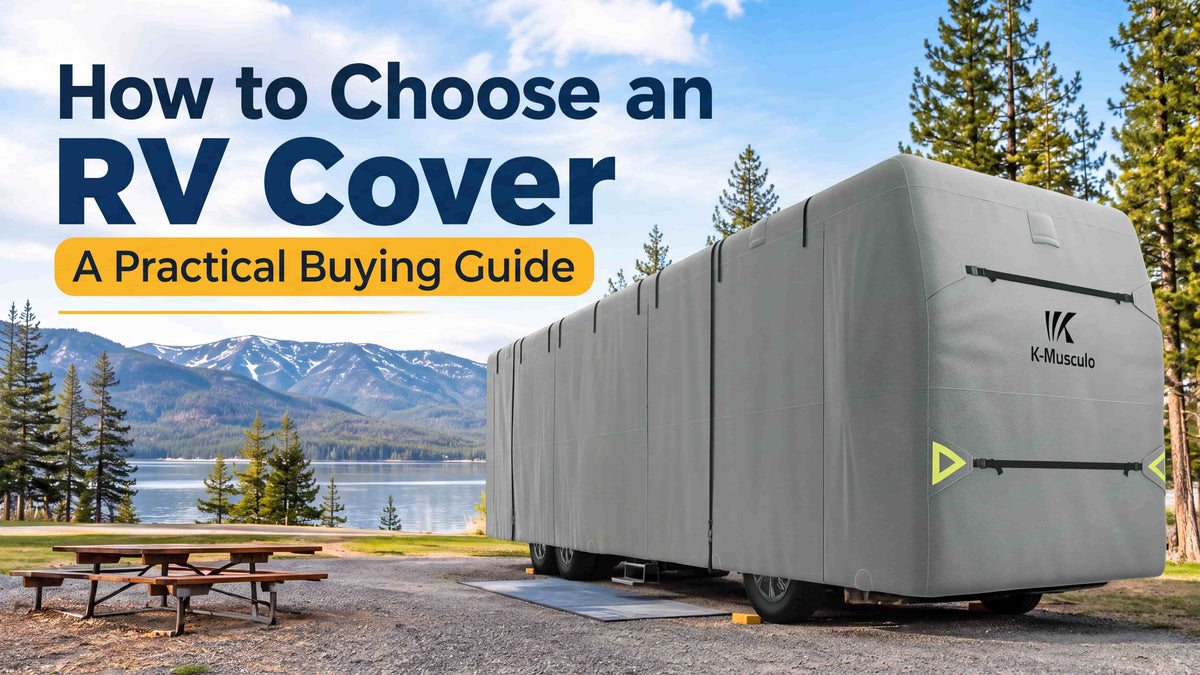
Choosing the right RV cover is about more than finding one that matches your vehicle's length. The best choice depends on your RV type, actual measurements, storage location, local climate, fabric construction, and the features that make a cover practical to use.
A properly selected RV cover can help protect your motorhome or travel trailer from sun exposure, rain, snow, dust, bird droppings, and everyday outdoor debris while it is parked. However, a cover that does not fit correctly or provide adequate ventilation may create additional problems.
This RV cover buying guide explains what to look for before ordering, how to compare different materials, and how to select a cover that fits your RV and storage needs.
1. Determine Which Type of RV Cover You Need
Before comparing materials or prices, identify your RV type. Different RV designs have different dimensions, body shapes, and coverage requirements.
A cover designed for one RV category may not fit another properly, even when their advertised lengths are similar.
Travel Trailer Covers
Travel trailers come in various lengths and exterior configurations. Rear ladders, spare tires, bumpers, and other accessories can affect the overall measurements.
When shopping for a travel trailer cover, check:
-
The complete exterior length required by the manufacturer.
-
The cover's stated width and height.
-
Whether the design accommodates your trailer's front profile.
-
Whether the cover includes reinforced corners and adjustable straps.
-
Whether zippered access panels align with your RV door.
A properly sized travel trailer cover should provide adequate coverage without excessive loose material.
Fifth Wheel Covers
Fifth wheels have a distinctive raised front section designed to connect to a fifth-wheel hitch.
Because of this shape, a fifth-wheel-specific cover is generally a better choice than a generic travel trailer cover.
Look for:
-
A design made for the raised front section.
-
Appropriate overall length and height.
-
Adequate coverage around the front cap.
-
Secure fastening points.
-
Access panels that work with your RV's layout.
If you own a fifth wheel, compare the actual cover dimensions with your RV before ordering.
Class A Motorhome Covers
Class A motorhomes are generally larger and taller than many travel trailers.
Their broad front profile and substantial exterior dimensions make proper sizing particularly important.
When comparing Class A RV covers, pay attention to:
-
Overall length, width, and height.
-
Reinforced front and rear sections.
-
Roof coverage.
-
Ventilation openings.
-
Securement straps.
-
Access to the entry door.
For larger motorhomes, consider how manageable the cover will be to install and remove.
Class C Motorhome Covers
Class C motorhomes have a distinctive cab-over section above the driver's cabin.
This changes the front profile and can affect how a cover sits around the windshield and upper front section.
Choose a cover specifically designed for Class C motorhomes and confirm that its dimensions accommodate your vehicle's shape.
Important: Always choose a cover based on its actual fit specifications rather than relying only on the RV category or model name.
2. Measure Your RV Before Buying a Cover
Incorrect measurements are one of the most common reasons an RV cover does not fit as expected.
Do not assume that the length printed in your RV owner's brochure is automatically the correct measurement for purchasing a cover.
Different manufacturers use different measuring methods. Some measurements include the hitch, while others exclude it. Some cover designs already account for rooftop accessories, while others require buyers to include them.
Always follow the measuring instructions for the specific cover you intend to purchase.
What Measurements Should You Check?
| Measurement | What to Check |
|---|---|
| Length | The front-to-rear measurement specified by the cover manufacturer |
| Width | The widest relevant exterior measurement |
| Height | The measurement specified from the RV body or base to the required top point |
Before measuring, identify which exterior components need to be included.
These may include:
-
Rear-mounted spare tires.
-
Exterior ladders.
-
Bumpers.
-
Air conditioning units.
-
Roof vents.
-
Antennas.
-
Other permanent exterior accessories.
Not every cover manufacturer uses the same measurement rules. For example, ADCO's measuring instructions include bumpers, spare tires, and ladders but generally exclude rooftop equipment and the hitch. K-Musculo's travel trailer product instructions specify including exterior accessories such as ladders, spare tires, air conditioners, and antennas.
Do not transfer one manufacturer's measuring rules to another product.
Should You Choose a Larger RV Cover?
If your RV measurement falls close to the upper limit of a cover's stated size range, check the next available size before ordering.
However, choosing a larger cover is not automatically better.
An oversized cover may leave excessive loose material, which can move in the wind and rub against exterior surfaces. An undersized cover may stretch across corners, seams, and other contact points.
Compare all available dimensions and ask the manufacturer for guidance if your measurements are close to a size boundary.
Practical tip: Write down your RV's measurements and compare them with the product's actual specifications before making a purchase.
3. Compare RV Cover Materials and Construction
The material affects how an RV cover handles weather exposure, moisture, abrasion, and everyday storage conditions.
There is no single material that is automatically best for every RV owner. Your climate, storage location, and intended use should influence your decision.
Nonwoven Polypropylene
Nonwoven polypropylene is commonly used in RV cover construction.
Potential advantages include:
-
Lightweight construction.
-
Convenient handling.
-
Breathable fabric options.
-
Practical use for seasonal storage.
However, protection levels vary between products. Basic polypropylene covers may provide less UV and weather resistance than more advanced multi-layer designs.
Check the manufacturer's actual specifications rather than assuming all polypropylene covers offer the same protection.
Polyester
Polyester is another common material used in outdoor covers.
Depending on its construction and coating, polyester can offer:
-
Good durability.
-
Resistance to everyday outdoor wear.
-
Water-repellent properties.
-
UV-resistant options.
Its performance depends on the fabric weight, weave, coating, seams, and overall construction.
A polyester label alone does not tell you how well a finished RV cover will perform.
Multi-Layer Fabric
Multi-layer RV covers combine different fabric layers to provide protection and support.
Some designs use stronger materials in areas that experience more exposure or contact, such as the roof and corners.
When comparing multi-layer products, check:
-
The construction of the top panel.
-
The material used on the sides.
-
Reinforced corner areas.
-
Seam construction.
-
Ventilation design.
-
Water and UV protection claims.
Are more fabric layers always better?
No. A higher layer count does not automatically mean better overall performance.
A well-designed cover with suitable materials, reinforced contact areas, proper ventilation, and secure fastening may be more practical than a cover with a higher advertised layer count but an unsuitable design.
How Should You Compare RV Cover Materials?
| Feature | Why It Matters |
|---|---|
| UV resistance | Helps reduce exposure to sunlight |
| Water resistance | Helps protect against rain and moisture |
| Breathability | Helps manage moisture beneath the cover |
| Tear resistance | Helps withstand normal handling and outdoor use |
| Abrasion resistance | Helps reduce wear at contact points |
| Fabric weight | Affects handling and installation |
| Seam construction | Influences overall cover durability |
Focus on the complete construction instead of choosing a product based on one material description.
4. Choose an RV Cover Based on Your Climate
Where you store your RV can be just as important as the type of cover you purchase.
An RV parked in a sunny, dry region faces different conditions from one stored in a rainy or snowy climate.
Hot and Sunny Climates
If your RV spends long periods outdoors in direct sunlight, look for a cover with clearly described UV-resistant construction.
Sun exposure can affect exterior finishes, decals, roof components, and other exposed materials.
Consider:
-
UV-resistant fabric.
-
Adequate roof coverage.
-
Durable seams.
-
Reinforced contact areas.
-
Suitable ventilation.
Rainy and Humid Climates
In areas with frequent rain or high humidity, moisture management is especially important.
A cover should help protect against precipitation while allowing trapped moisture to escape.
Look for:
-
Breathable fabric.
-
Built-in ventilation openings.
-
Suitable water protection.
-
Properly constructed seams.
-
A secure fit that limits unnecessary movement.
A cover that blocks rain but provides inadequate ventilation may allow condensation to accumulate underneath.
Cold and Snowy Climates
For winter storage, look for a cover designed for seasonal outdoor exposure.
Useful features may include:
-
Durable top construction.
-
Water-resistant or waterproof materials, as specified.
-
Reinforced corners.
-
Secure fastening straps.
-
Ventilation openings.
Keep in mind that an RV cover is not a structural snow-support system. Follow your RV and cover manufacturer's guidance for monitoring and removing accumulated snow.
Windy Storage Locations
Wind deserves special consideration.
A loose cover may repeatedly move against the RV's paint, windows, trim, decals, and exterior corners.
If your storage area experiences strong winds, prioritize:
-
A suitable fit.
-
Adjustable securing straps.
-
Reliable buckles.
-
Reinforced contact areas.
-
Proper installation.
No fabric cover should be assumed to withstand every wind condition.
If your storage location regularly experiences severe winds, compare the risks of using a cover with the benefits of sheltered storage.
5. Look for These Important RV Cover Features
Once you have identified the right RV type, size, and material, compare the features that affect everyday use.
Reinforced Corners
Corners are common contact points between the RV and its cover.
When the fabric moves or rubs against exterior edges, these areas may experience additional wear.
Reinforced corners can provide additional material in areas that need it.
Check whether the reinforcement is located where your RV's shape and exterior accessories require it.
Ventilation Openings
Ventilation is important because moisture can accumulate beneath an RV cover.
Built-in vents help support airflow and moisture management.
Look for vent openings that are appropriately positioned and designed for the cover.
Remember that ventilation features do not eliminate the need to inspect your RV during long-term storage.
Adjustable Straps and Buckles
A secure fastening system helps keep the cover in position.
Look for:
-
Adjustable straps.
-
Secure buckles.
-
Accessible fastening points.
-
Suitable underbody connections.
-
Instructions for proper tension adjustment.
The goal is a secure fit without pulling the fabric excessively tight.
Zippered Access Panels
Zippered access panels can be particularly useful when you need to enter your RV during storage.
Before purchasing, check:
-
Whether the cover has an access panel.
-
Where the panel is positioned.
-
Whether it aligns with your RV's entry door.
-
Whether additional access points are available.
Do not assume every RV cover includes the same access features.
Reflective Details
Reflective strips may improve the visibility of a covered RV in low-light conditions.
This can be useful when an RV is parked in a storage area where people or vehicles move nearby.
Check the product specifications to confirm whether reflective features are included.
Included Accessories
Accessories can add convenience and reduce the need to purchase additional protective items separately.
Depending on the product, an RV cover package may include:
-
Tire covers.
-
Gutter covers.
-
Repair patches.
-
Storage bags.
-
Additional securing straps.
Always review the actual package contents. Included accessories vary by RV cover model.
6. Full RV Cover vs. RV Roof Cover: Which Should You Choose?
An important buying decision is whether you need a full-body RV cover or a roof-only RV cover.
These products serve different purposes.
A full RV cover is designed to cover the roof and much of the RV's exterior body, while an RV roof cover focuses on the upper surface.
| Comparison | Full RV Cover | RV Roof Cover |
|---|---|---|
| Main coverage | Roof and exterior body | Roof area |
| Sidewall protection | Yes, depending on design and fit | Limited or none |
| Installation | Covers the main RV body | Installed over the roof |
| Main purpose | Broad exterior protection | Targeted rooftop protection |
| Tire protection | May be included separately | Not normally included |
When Should You Choose a Full RV Cover?
A full RV cover may be the better option when:
-
Your RV is stored outdoors for extended periods.
-
You want to protect both the roof and sidewalls.
-
Your storage location exposes the vehicle to dust and debris.
-
You want broader exterior coverage.
When Should You Choose an RV Roof Cover?
A roof-only cover may be more suitable when:
-
You primarily want to cover the upper surface.
-
Your RV already has some side protection from a shelter.
-
You do not need full-body coverage.
-
Your storage requirements focus on the roof.
Remember that a roof-only cover does not provide the same sidewall protection as a full RV cover.
Choose according to the actual area you want to protect.
7. Check the Warranty, Size Chart, and Package Contents
Before placing an order, review the product information carefully.
A good buying decision involves more than comparing prices.
Review the Size Chart
Confirm that the product is available in a size that accommodates your RV's measurements.
Check the manufacturer's measurement instructions and compare length, width, and height.
Check the Included Accessories
Read the package list to understand exactly what is included.
If tire covers, gutter covers, or repair patches are important to you, confirm their quantities before ordering.
Understand the Warranty
Check:
-
Warranty duration.
-
Covered manufacturing defects.
-
Exclusions.
-
Claim requirements.
-
Available customer support.
Do not assume that every RV cover has the same warranty conditions.
Compare the Total Value
A lower-priced cover may provide basic protection, while a more feature-rich model may offer additional convenience.
Instead of choosing solely by price, consider:
-
Material construction.
-
Fit.
-
Ventilation.
-
Reinforced areas.
-
Fastening system.
-
Included accessories.
-
Warranty coverage.
The best choice is the one that meets your actual storage needs and fits your RV properly.
8. RV Cover Buying Checklist
Before ordering, use this checklist to review the most important details.
RV Compatibility
-
Identify whether you own a travel trailer, fifth wheel, Class A, or Class C motorhome.
-
Confirm that the cover is designed for your RV type.
-
Check the shape and access-panel layout.
Measurements
-
Measure the RV according to the manufacturer's instructions.
-
Record the required length, width, and height.
-
Account for exterior accessories when instructed.
-
Compare your measurements with the available size chart.
Material and Protection
-
Check the fabric construction.
-
Review UV and water protection claims.
-
Look for reinforced contact areas.
-
Consider breathability and ventilation.
Practical Features
-
Check securing straps and buckles.
-
Confirm access-panel placement.
-
Review reflective details.
-
Verify included accessories.
Before Ordering
-
Review warranty terms.
-
Confirm package contents.
-
Compare the total value.
-
Contact the seller if your measurements are close to a size boundary.
Taking a few minutes to review these details can help you avoid choosing a cover that does not match your RV or storage conditions.
Frequently Asked Questions About Choosing an RV Cover
1. What size RV cover do I need?
The correct size depends on your RV's actual dimensions and the manufacturer's measuring instructions.
Measure the required length, width, and height, including exterior accessories when specified. Then compare your measurements with the product's size chart.
Do not rely solely on the length listed in your RV brochure.
2. What is the best material for an RV cover?
There is no single best material for every RV.
Nonwoven polypropylene, polyester, and multi-layer fabrics each have different construction characteristics.
Choose according to your climate, storage conditions, desired breathability, UV protection, and durability requirements.
3. Are RV covers waterproof?
Some RV covers use waterproof or water-resistant materials, but the level of protection varies by product.
Check the manufacturer's specifications, including the fabric, seams, and ventilation design.
A cover should provide suitable weather protection while also allowing moisture management.
4. Do RV covers cause mold or mildew?
An RV cover does not automatically cause mold or mildew.
Problems may occur when moisture becomes trapped beneath the cover, particularly when the RV is covered while wet or when ventilation is inadequate.
Clean and dry your RV before installation, keep ventilation openings clear, and inspect the covered vehicle periodically.
5. Should I buy a full RV cover or a roof-only cover?
Choose a full RV cover if you want broader protection for the roof and exterior body.
Choose a roof-only cover if your primary goal is protecting the upper surface and you do not need full sidewall coverage.
The two products have different coverage areas and should not be treated as interchangeable.
6. How do I keep my RV cover from blowing off?
Choose a properly sized cover with an appropriate fastening system.
Use the supplied straps and buckles according to the manufacturer's instructions, adjust the fit without excessive tension, and inspect the fastening points periodically.
A secure fit can help reduce movement, although no cover is guaranteed to withstand every wind condition.
Find the Right RV Cover for Your Storage Needs
Choosing an RV cover starts with understanding your vehicle, measuring it correctly, and identifying the protection you need.
Whether you own a travel trailer, fifth wheel, Class A motorhome, or Class C motorhome, compare the material, ventilation, reinforced areas, fastening system, and included accessories before making your decision.
At K-Musculo, we offer RV covers designed for different RV types and outdoor storage needs.
Explore our RV Covers Collection to compare available options.
You can also explore our Travel Trailer RV Cover, Class A RV Cover, and Class C RV Cover to review their specifications and available sizes.
If you own a fifth wheel, see our 5th Wheel RV Cover.
Choose the right fit, compare the features that matter, and give your RV a more suitable layer of protection during storage.
K-Musculo — Built to Protect Every Journey.
Share:
How to Choose the Right RV Roof Cover: Fit, Fabric & Storage
Should You Cover Your RV in Winter? Benefits, Risks & Fit Tips